Caribbean inter-governmental organisation unveils USD 4.1 million SOILCARE Phase 2 initiative and charts a bold new chapter for sustainable land management on the Nature Isle.
ROSEAU, DOMINICA — The Partnership Initiative for Sustainable Land Management (PISLM) delivered a landmark presentation at the Ministry of Environment, Rural Modernisation, Kalinago Upliftment and Constituency Empowerment’s annual Planning Retreat on Wednesday, 4 February 2026, outlining a comprehensive vision for Dominica’s transition from post-disaster recovery to long-term climate resilience. Held at the historic Cabrits National Park Conference Room in Portsmouth, the retreat brought together senior government officials, department heads, and international development partners to assess progress, strengthen coordination, and chart strategic priorities for the remainder of Financial Year 2025/2026 and the year ahead.
PISLM’s participation in the Development Partners Forum — a dedicated afternoon session featuring presentations from key implementing partners — underscored the organisation’s deepening institutional relationship with the Government of Dominica and its central role in advancing sustainable land management across the Nature Isle.
A Retreat with Purpose
Convened under the theme “Building a Resilient Public Service: A Collective Response,” the full-day retreat was opened by the Honourable Cozier Frederick, Minister for Environment, Rural Modernisation, Kalinago Upliftment and Constituency Empowerment, with welcome remarks from Permanent Secretary Lisa Valmond. The gathering examined progress across the Ministry’s diverse portfolio, spanning constituency empowerment, the National Employment Programme, Kalinago upliftment, environmental policy, solid waste management, and forestry and wildlife conservation.
The afternoon Development Partners Forum convened presentations from six implementing partners, including the GEF Eco-Tourism for Biodiversity Protection initiative, the UNDP’s GEF-8 Global Biodiversity Framework programme, the UNDP’s Strengthening Community Resilience in the Kalinago Territory (SCR-K) project, the Commonwealth Secretariat’s Climate Finance Advisory programme, PISLM, and the Caribbean Community Climate Change Centre (5Cs). The forum provided a critical platform for aligning international support with Dominica’s national priorities and ensuring that resources are deployed efficiently and without duplication.
PISLM: A Proven Track Record on Dominican Soil
Presenting on behalf of PISLM, National Project Coordinator Euan James delivered a comprehensive twenty-minute briefing that traced the organisation’s decade-long engagement with Dominica across two completed GEF-funded initiatives and introduced a transformational new investment poised to reshape the country’s approach to land degradation and soil health.
PISLM is an independent inter-governmental organisation established in 2003 and headquartered in St. George’s, Grenada, serving 16 Caribbean Small Island Developing States. Formally designated an IGO in April 2024, PISLM operates as a COTED-endorsed GEF Executing Agency with a mission to harmonise policies, deliver innovative solutions, and build capacity across the Caribbean in sustainable land management and soil health. The organisation’s key partners include the United Nations Environment Programme (UNEP), the Global Environment Facility (GEF), the United Nations Convention to Combat Desertification (UNCCD), the Food and Agriculture Organization (FAO), CARICOM, and the University of the West Indies.
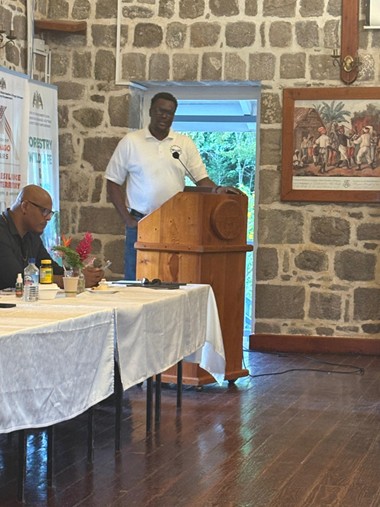
Euan James, PISLM National Project Coordinator, addresses the Development Partners Forum at the Cabrits National Park Conference Room.
Sustainable Land Management Project: Laying the Foundation
The presentation detailed the achievements of PISLM’s Sustainable Land Management (SLM) Project (GEF ID: 9667), which focused on landscape-level planning, the introduction of agricultural best practices, and the strengthening of regulatory frameworks. The project delivered five Parish Land Use Plans developed in partnership with Dominica’s Department of Physical Planning — exceeding the original target of four — and established sustainable land management practices across 2,000 hectares of agricultural landscape. In the Batali, Coulibistrie, and La Plaine watersheds, 19,000 trees were planted along riparian zones, contributing to the rehabilitation of over 4,000 hectares of critical catchment area.
On the policy front, the project supported the finalisation and submission of the Environment Bill to Cabinet and achieved a 71 per cent improvement in Dominica’s institutional capacity score on the UNDP Capacity Scorecard, rising from 21 to 36. Thirty model farms were established across the country, featuring 16,000 metres of grass barriers, 1,000 metres of windbreaks, 8,000 metres of drainage trenches, and 350 cubic metres of water harvesting capacity. The initiative directly benefited 1,300 Dominicans.
Post-Hurricane Maria Project: Restoring What Was Lost
PISLM’s Post-Hurricane Maria Project (GEF ID: 9978) addressed the catastrophic environmental damage inflicted by the 2017 hurricane, which stripped Dominica’s forest canopy and devastated the agricultural sector. The project restored 500 hectares of denuded land, establishing approximately 300,000 plants through a combination of direct planting and strategic partnerships with eight private nurseries. Government nursery facilities were rehabilitated to a capacity of 10,000 seedlings per year each, creating a lasting institutional asset for future restoration efforts.
The project also advanced agricultural resilience through the assessment of 65 farms using the Caribbean Soil Assessment Card (C-SAC) tool and the delivery of IICA business planning training to 150 farmers. A National Food Security Policy was drafted, and the project reached a total of 2,500 beneficiaries, with 52 per cent female participation — a significant achievement in gender-responsive programming. Together, the two completed projects brought a cumulative 2,500 hectares under improved management, established nearly 300,000 plants, advanced two major pieces of national legislation, and directly engaged 3,800 Dominican citizens in sustainable land management activities.
SOILCARE Phase 2: A USD 4.1 Million Investment in Dominica’s Future
The centrepiece of PISLM’s presentation was the introduction of SOILCARE Phase 2, a transformational five-year initiative running from January 2026 to January 2031, backed by a total investment of USD 4.13 million — comprising USD 1.8 million in GEF grant financing and USD 2.33 million in Government of Dominica co-financing. The project’s primary objective is to strengthen Caribbean SIDS with the tools, policies, and direct interventions needed to achieve Land Degradation Neutrality (LDN) and build lasting climate resilience.
SOILCARE Phase 2 is structured around five integrated components: scientific and data sovereignty, landscape restoration, drought risk mitigation, financial innovation, and capacity and policy reform. Three intervention sites have been identified in Dominica: the Quayaneri Watershed (200 hectares of restoration addressing forest clearing, riverbank destabilisation, and landslide risk), the Coulibistrie Watershed (100 hectares targeting steep topography, shallow soils, and severe water constraints), and the Kalinago Territory (100 hectares addressing erosion on steep slopes and nutrient depletion on Indigenous lands). A further 1,600 hectares are targeted for scaled impact through indirect interventions.
Among the project’s flagship deliverables are the establishment of a Tier 1 Soil Laboratory with international quality assurance protocols under the Caribbean Soil Laboratory Network (CARSOLAN), Dominica’s first comprehensive national soil survey with modern digital soil mapping, the creation of a Small Farmers Drought Mitigation Scheme for the Coulibistrie area, and the launch of a Youth Agri-Business Initiative (YABI) providing microloans, mentoring, and skills training to young farmers. SOILCARE Phase 2 targets the sequestration of over 304,000 tonnes of CO₂ equivalent over twenty years, a 15 per cent increase in soil productivity, and the engagement of 1,300 direct beneficiaries, with a minimum 40 per cent female participation target.
A Partnership Recognised at the Highest Level
PISLM’s contributions at the retreat drew commendation from the Ministry’s most senior leadership. In a follow-up communication to PISLM, Permanent Secretary Lisa Valmond praised the organisation’s engagement, noting that PISLM’s presence and participation “really enriched the discussions and provided important perspectives on ongoing and planned interventions.” The Permanent Secretary further emphasised that the retreat had reinforced a shared commitment to collaboration, the avoidance of duplication, and the strategic alignment of resources and initiatives with national priorities.
“Your continued partnership is critical as we move from planning to implementation and work collectively to deliver meaningful and sustainable outcomes for the people of Dominica,” the Permanent Secretary stated, signalling the Government’s intention to deepen its institutional relationship with PISLM in the years ahead.
Looking Ahead: A Strategic Partner for the Nature Isle
PISLM’s participation in the Planning Retreat marks a significant moment in the organisation’s relationship with Dominica. As the only inter-governmental organisation in the Caribbean dedicated exclusively to sustainable land management and soil health, PISLM offers the Government of Dominica direct access to specialised expertise in land degradation science, drought resilience and soil conservation, and connections to a network of 16 Caribbean member states engaged in peer learning and policy harmonisation.
With SOILCARE Phase 2 now commencing and a proven track record of delivery across two completed projects, PISLM is positioned as a long-term institutional partner capable of supporting Dominica’s ambitious vision of becoming the world’s first climate-resilient nation. The organisation’s presentation at the retreat closed with a commitment that resonated across the conference room: “Together, let us move Dominica from recovery to lasting resilience.”